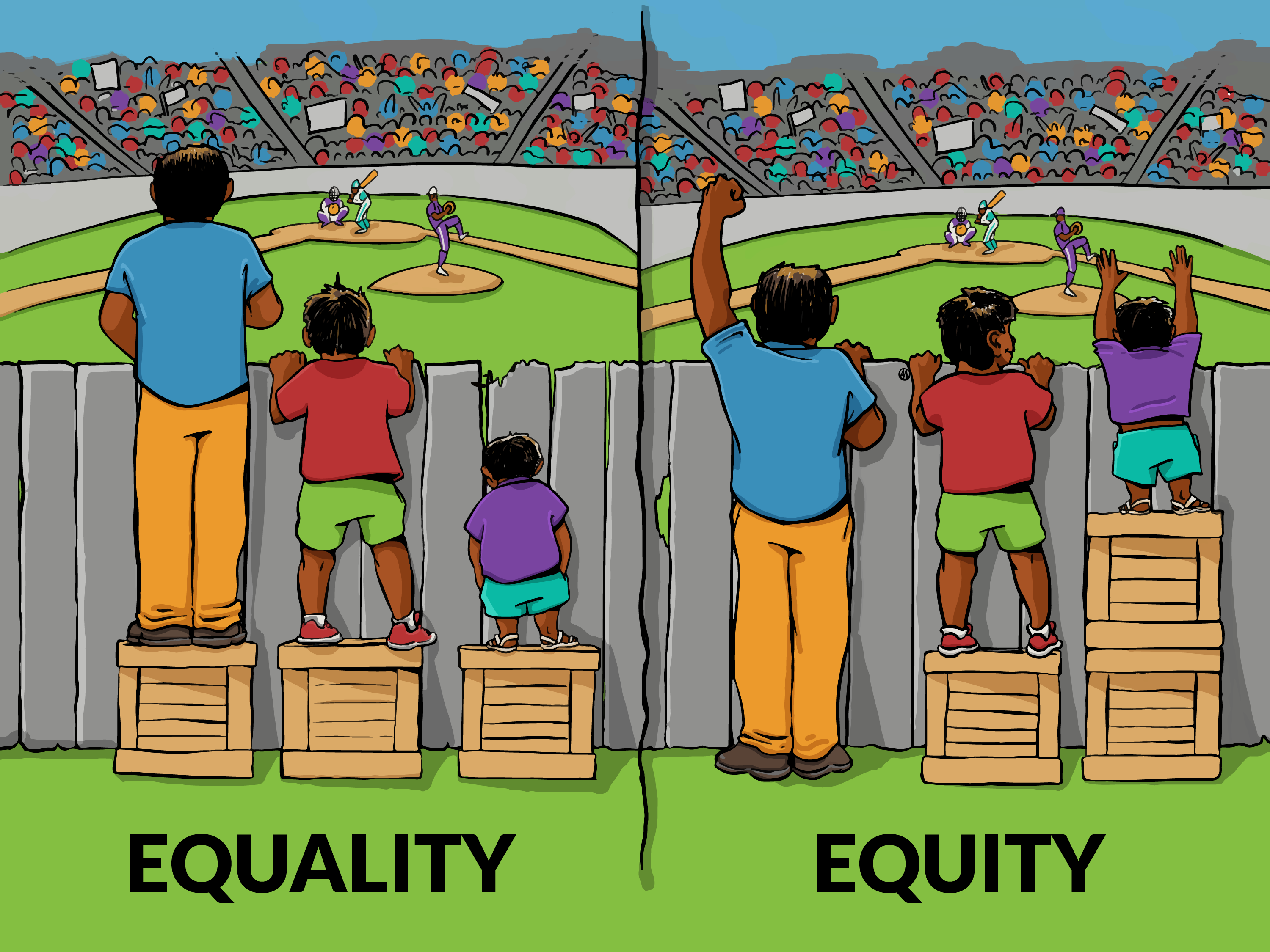
As a manager of a great team of people; young, old, male, female, short, tall etc. I must manage equality in the workplace. An easy thing to do in this modern age of people generally understanding what equality is. However, as I often tell my children, nothing is simple!
Imagine two people looking over a fence. One is taller and has a good view. The other is shorter and can’t see over the fence. How do we provide equality for them? Simple, right? We give the shorter guy a box to stand on, and then both have an equal view.
Hang on though. If we are handing out boxes, doesn’t the tall guy have an equal right to one? OK, we give both guys a box. Now the tall guy still has the better view but we’ve given both of them an equal opportunity to see further.
Of course, as an alternative, we could cut down the height of the fence. Both guys would then have a better view but the taller guy would still see further.
Or we could cut a notch in the fence for the shorter guy.
But the fence is presumably there for a reason. Have we compromised its usefulness by cutting the top off it?
This is all nonsense cry some people. Why waste money on boxes or saws? Just make the taller guy kneel down and then both have an equal view.
Hmm, Let’s try another way. The world is not flat. Why don’t we let the shorter guy climb a hill so that he and the taller guy have the same view?
Because we’ve made the shorter guy work unfairly hard to get an equal view.
In any event the hilltop is prime real estate and is owned by a wealthy person who does not welcome random intruders of any height.
While a vocal lobby is pressing for equality for short people, the “short-sighted” lobby also wants to get equality for its members. So we give boxes to some, spectacles to others, and even both spectacles and a box to some or neither to others?
Perhaps the shorter guy isn’t interested in the view over the fence. He’s happy to get the view described by the taller guy. Both might be equally happy without boxes, saws or spectacles.
Perhaps the short guy has a higher disposable income and is happy to buy his own box.
Nope. Now we’ve discriminated against poorer, shorter people.
For a moment let’s accept that resources (whether that means boxes or anything else) aren’t infinite.
Perhaps we have 10 guys of varying heights and varying quality of vision, but we only have three boxes, two saws and one pair of glasses. Who gets which and for how long and at what cost paid by whom in order to provide an equal solution?
To solve those questions equitably, are we spending money on an equal-opportunity box allocation system that could have been spent on more boxes?
Equality: Such a simple concept.